Disclosure: This post contains affiliate links. If you buy through them, I may earn a commission at no extra cost to you. As an Amazon Associate I earn from qualifying purchases. Read our full affiliate disclosure.
A track saw is a plunge-cut circular saw that rides on an aluminum guide rail. You lay the rail on your cut line, set the saw on it, and push. The result is a straight, clean, splinter-free cut that looks like it came off a table saw, even on a full 4×8 sheet of plywood lying on the floor.
That sounds like magic until you see the price difference. A regular circular saw does the same basic job for a fraction of the cost, and with a simple homemade guide it can get surprisingly close. So does a beginner actually need a track saw? This guide explains how the two tools differ, what each one is good at, and a simple way to decide which one belongs in your shop first.
What Is a Track Saw?
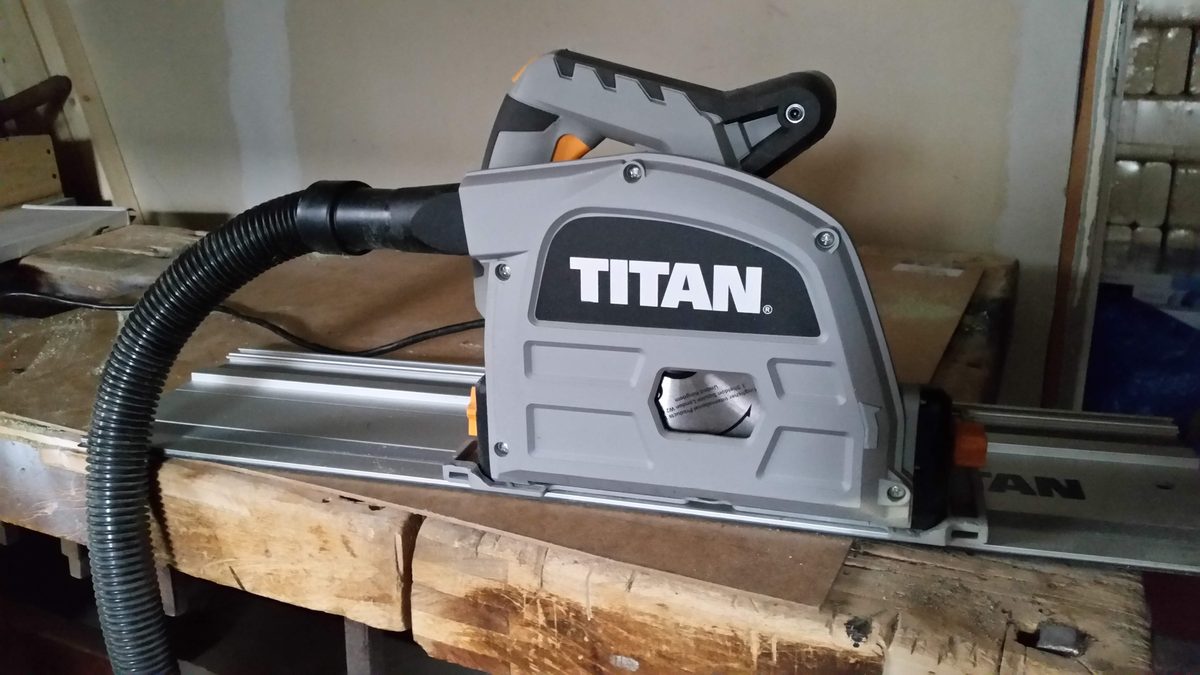
A track saw has three features that set it apart from an ordinary circular saw:
- It runs on a rail. The base has a groove that locks onto a matching guide rail, so the saw can only travel in a straight line. Most rails have a grippy strip underneath, so on many cuts you don’t even need to clamp them down.
- It plunges. The blade sits fully inside the housing until you push the saw down. That makes it easy to start a cut in the middle of a panel (for a sink cutout, for example) and keeps the blade covered between cuts.
- It reduces tear-out. The rail has a rubber or plastic splinter strip along its edge that presses the wood fibers down right at the blade. That’s why track saw cuts on veneered plywood look so clean on both faces.
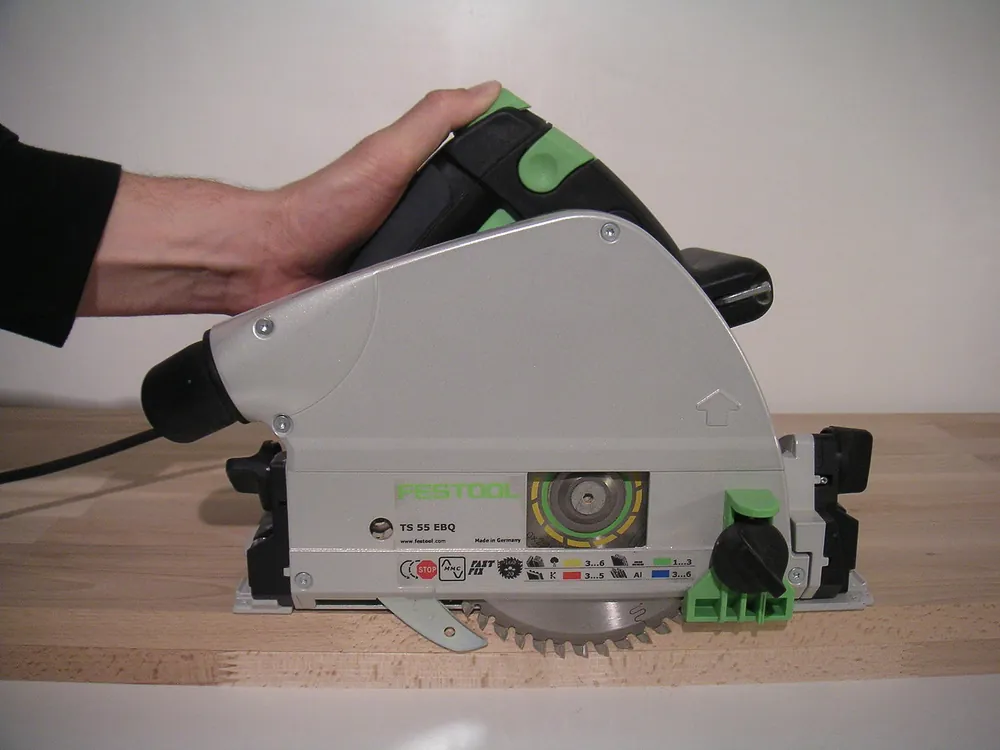
Most track saws also have good dust collection, because the blade is enclosed and there’s a port for a shop vacuum. The edge of the rail is the cut line, so you line the rail up with your pencil marks and don’t have to measure any offset.
What Is a Circular Saw?
A circular saw (often called a “skill saw” after the Skil brand) is the handheld saw most of us buy first. The blade hangs below a flat shoe, and you guide the saw freehand along a line or against a straightedge. It’s built for speed and versatility: breaking down plywood, cutting 2x4s and 2x6s to length, ripping boards, and rough framing work.
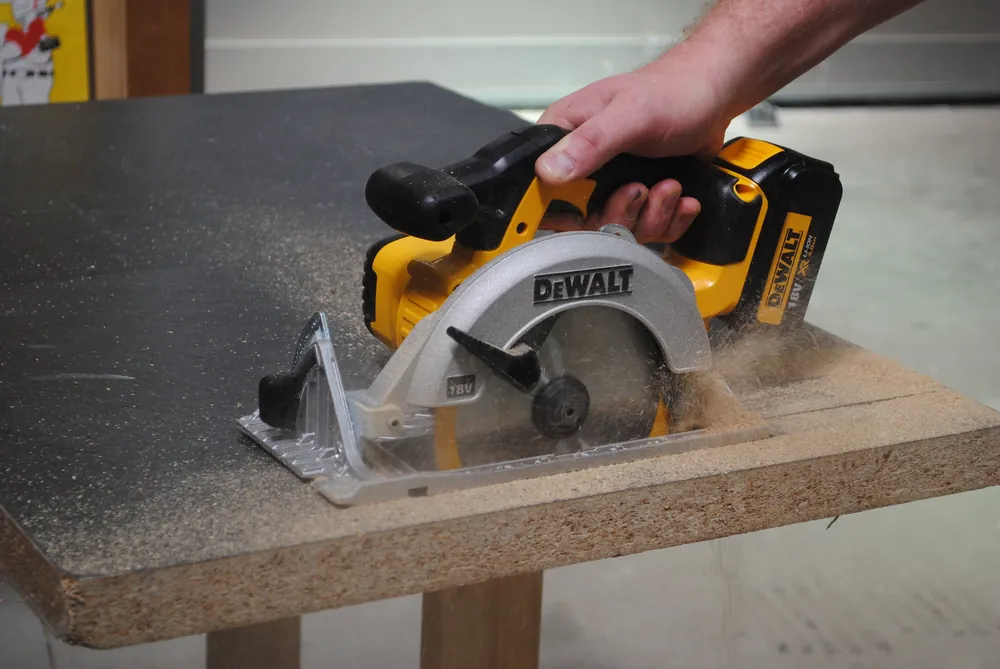
Two common styles exist in the US:
- Sidewinder. The motor sits beside the blade. Light, compact, and the most common style for DIYers.
- Worm drive (or rear handle). The motor sits behind the blade. Heavier, with more torque, and popular with framers.
Most full-size circular saws use a 7-1/4 inch blade, which cuts through a 2x board at 90 degrees in one pass. There are also compact and mini circular saws with smaller blades. They’re light and handy for plywood and thin stock, but check the listed cutting depth, because many can’t get through a 2×4 in one pass. If you want a small, easy-to-handle saw for sheet goods and trim, the WORKPRO 20V 4-1/2″ mini circular saw (check price on Amazon) is one option; just know its limits before you plan to cut framing lumber with it.
Track Saw vs Circular Saw: Side-by-Side Comparison
| Feature | Track saw | Circular saw |
|---|---|---|
| Straight long cuts | Excellent, guided by the rail | Good with a clamped straightedge, harder freehand |
| Cut quality on plywood | Very clean, minimal tear-out | More splintering unless you use tape, a fine blade, or a zero-clearance guide |
| Cutting 2x lumber to length | Possible but slow to set up | Fast and natural |
| Plunge cuts | Built for it | Possible but awkward and riskier |
| Dust collection | Usually very good | Usually poor to fair |
| Setup time per cut | Lay the rail on the marks | Measure offset, clamp guide (or cut freehand) |
| Cost | Much higher, and rails are extra on some models | Low to moderate |
| Best for | Cabinets, furniture from sheet goods, finish-quality cuts | General DIY, framing, outdoor projects, rough breakdown |
Prices change often and vary a lot by brand and battery platform, so compare current listings rather than relying on any number you read online (including ours).
When a Track Saw Is Worth It
A track saw earns its keep when most of your projects start with sheets of plywood or MDF. Think kitchen or garage cabinets, built-ins, bookshelves, closet organizers, and desks. In those projects, every panel edge shows or has to join tightly with another panel, and a clean, square first cut saves you sanding, filling, and frustration later.
It’s also a strong choice if:
- You have no room for a table saw. A track saw and rail hang on a wall. In a one-car garage or apartment-adjacent shop, that matters. (Our small garage shop layout guide shows how fast floor space disappears.)
- You work alone with full sheets. Wrestling a 4×8 sheet across a table saw by yourself is awkward and unsafe. With a track saw, the sheet stays put on a sheet of foam insulation or a pair of sawhorses and the tool moves instead.
- You care about dust. Hooked to a shop vac, a track saw is far cleaner than a circular saw, which helps if you work in a garage attached to the house.
- You want to straighten rough lumber edges. Laying the rail along a crooked board edge and trimming it gives you a straight reference edge, a job usually done on a jointer or table saw.
When a Circular Saw Is the Better Pick
For most beginners, a circular saw is the smarter first purchase. It’s one of the tools we recommend in our essential woodworking tools for beginners list for a reason:
- You’re building with 2x4s and construction lumber. Workbenches, sawhorses, raised beds, outdoor furniture, and shop shelving are mostly crosscuts on dimensional lumber. A circular saw handles that quickly. Our 2×4 workbench plan and miter saw stand plan can both be built with one.
- Budget is tight. The money you save can go toward clamps, a drill, and a sander, which you’ll use on every project.
- Your cuts don’t need to be furniture-grade. For shop projects, rough breakdown, and anything that gets painted or sanded, a circular saw with a decent blade is plenty.
- You already own a battery platform. Most major brands sell a circular saw that shares batteries with your drill, which keeps the cost down further.
If you’re mapping out what to buy first with limited money, our $300 beginner tool plan walks through the order we’d buy things in.
Get Track-Saw-Like Cuts From a Circular Saw
You can close much of the quality gap without buying a new saw. Here are four upgrades, from cheapest to most involved:
1. Use the right blade
The blade that comes with many circular saws is a low tooth-count blade made for fast framing cuts. For plywood, a fine-finish blade with more teeth (often 40 or more on a 7-1/4 inch blade) cuts much cleaner. It’s one of the cheapest improvements you can make.
2. Score and tape the cut line
Run a strip of painter’s tape along the line and score it with a utility knife on the good face. Cut with the good face down, because a circular saw blade spins up through the material and tears out the top face.
3. Clamp a straightedge
Any straight, rigid edge works: a factory edge of plywood, a level, or an aluminum straightedge. Measure the distance from your blade to the edge of the saw’s shoe, offset the straightedge by that amount, and clamp it at both ends. A pair of VEVOR 36″ quick-change F clamps (check price on Amazon) are long enough to reach across most panels.
4. Build a DIY saw guide (a “poor man’s track saw”)
This is the classic workshop jig and a great first project:
- Cut a strip of 1/4-inch plywood or hardboard about 12 inches wide and as long as your longest cut (8 feet for full sheets).
- Glue and screw a straight 3- to 4-inch-wide strip of 1/2- or 3/4-inch plywood on top, near one edge, using a factory edge as the fence. Keep the screws clear of where the saw will run.
- Once the glue dries, run your circular saw along the fence and trim off the excess base. The base edge is now exactly where your blade cuts.
- To use it, line the base edge up with your pencil marks, clamp both ends, and cut with the saw’s shoe riding against the fence.
Because the base edge supports the wood fibers right at the cut, it also reduces splintering on the top face. Label which saw it was made for, since the offset is different for every saw and blade.
There are also aftermarket guide rails and rail adapters that let a standard circular saw ride on a track. They’re a middle ground in price and convenience; read the compatibility notes carefully before buying one.
What to Look For If You Do Buy a Track Saw
Festool, Makita, DeWalt, Milwaukee, Bosch, and several budget brands all make track saws. Instead of chasing a specific model, check these points:
- Rail length. To rip a full 8-foot sheet in one go, you need a rail of roughly 100 inches or more, or two shorter rails joined with connectors. Many kits ship with a shorter rail, so check what’s included.
- Rail compatibility. Some brands use a shared rail profile, which gives you more options for rails, clamps, and accessories later.
- Corded or cordless. Cordless is convenient on a job site and pairs well with batteries you already own; corded models often cost less and never run out of charge mid-cut.
- Depth of cut and bevel range. Make sure it can cut through the thickest material you plan to use, at 90 and 45 degrees.
- Anti-kickback and riving features. Many track saws have a riving knife or a kickback stop. Those are worth having.
- Dust port size. Check that it fits your shop vacuum hose or that an adapter is available.
If you buy into a battery system, it usually makes sense to stay with that brand. If you’re shopping around, the WORX store (check current prices) is worth a look for budget-friendly cordless saws and accessories.
Safety Tips for Both Saws

- Wear safety glasses and hearing protection every time, and a dust mask when cutting MDF.
- Support the workpiece on both sides of the cut so it doesn’t pinch the blade. Cutting on a sheet of rigid foam insulation on the floor is a simple, safe way to break down plywood.
- Set the blade depth so it extends only about 1/4 inch below the material.
- Let the blade reach full speed before it touches the wood, and let it stop before lifting the saw.
- Keep the cord (or your body) out of the cut path, and never reach under the workpiece.
- Unplug the saw or remove the battery before changing blades.
So, Does a Beginner Need a Track Saw?
Here’s the simple version:
- Buy a circular saw first if you’re just starting out, building mostly with 2x lumber, or working with a small budget. Add a fine-finish blade and build a DIY saw guide, and you’ll handle most plywood cuts well.
- Consider a track saw once you find yourself regularly building cabinets, shelving, or furniture from plywood, especially if you have no room for a table saw or you work alone with full sheets.
- Many woodworkers end up owning both. The circular saw handles rough lumber and outdoor work; the track saw handles finish-quality panel cuts.
Neither tool will make up for a bad plan, so before you buy, think about the next three projects you actually want to build. If they’re things like our beginner bookshelf, a circular saw with a good guide will get you there. If they’re a full set of plywood cabinets, a track saw starts to look like a great investment.
FAQ: Track Saw vs Circular Saw
Can a track saw replace a table saw?
For breaking down sheet goods and making straight rips on panels, a track saw can do most of what a table saw does, in less space. It’s slower for repetitive narrow rips and small parts, and it can’t do things like dado stacks the same way. Many small-shop woodworkers happily use a track saw instead of a table saw.
Can I use a circular saw on a track?
Not directly on a brand’s track saw rail, because the saw base won’t lock into the rail groove. You can use a DIY saw guide, or buy an aftermarket rail system with an adapter plate designed for regular circular saws.
Is a track saw safer than a circular saw?
It can be. The blade stays enclosed until you plunge, the rail keeps the saw on a straight path, and many models include kickback protection. But any saw can kick back if the work isn’t supported properly, so the same safety habits apply.
Can a track saw cut 2x4s?
Yes, as long as its depth of cut is deep enough, which most full-size track saws are. It’s just slower to set up the rail for short crosscuts than to grab a circular saw or miter saw.
What size track do I need?
For crosscutting a 4-foot-wide sheet, a rail around 55 inches is common. For ripping a full 8-foot sheet in one pass, you need around 100 inches or more, either as one long rail or two joined rails.
What’s the difference between a circular saw and a skill saw?
Nothing, in practice. “Skill saw” comes from the Skil brand, which made early handheld circular saws, and the name stuck as a common nickname for any circular saw.
Final Thoughts
A track saw is a fantastic tool, but it’s a specialist. A circular saw is the generalist that most beginners should own first, and with a good blade and a homemade guide it covers far more ground than people expect. Start there, build a few projects, and upgrade to a track saw when sheet goods and clean panel cuts become your everyday work.
Next, put that saw to work: browse our easy woodworking projects for beginners and pick one for this weekend.
Featured photo: Blind cyclist, CC BY-SA 4.0, via Wikimedia Commons (cropped)